A tiny head that fixes a late robot policy
Robot models answer late, so the robot acts on an old plan. A tiny add-on gets back most of what the delay costs, 74% to 90%. Telling it how late it is adds nothing.
- Question
- Can a small RL head recover what inference delay costs a frozen action-chunk policy?
- Result
- Mostly. 74% to 90% on bursty delays, 89% on a delay pattern it never trained on.
Same scenario, three controllers: naive async, real-time chunking (RTC), and RTC with the learned head. An illustration, not evidence.
Why
The models that drive robots are large, and large models are slow. A robot can't stop and wait for one. So it keeps moving on the last plan it got, and that plan was made for a world that has already changed.
The usual answers are a faster model or a better way to join the old plan to the new one. I tested a cheaper one. Leave the big model alone and add a tiny one that corrects each action at the last moment.
Two things came out of it. The tiny model gets back most of what the delay costs. And telling it how late the plan is did not help at all.
Problem
A robot policy plans 8 steps at a time. Its next plan arrives 1 or 4 steps late, sometimes in bursts. Meanwhile the world keeps moving and the robot keeps running an old plan.
Setup
- Task: Kinetix catcher, a simulated craft with an arm. Structured state, no pixels.
- Base policy: the released RTC flow policy, frozen.
- On top: a 49k-parameter head that adds a small bounded correction to each action. Trained with PPO.
- 3 training seeds per method, 1,024 held-out episodes per cell. 5.5 GPU-hours on one RTX 5090.
Result
| Method | Bursty delays | Never-seen longer bursts |
|---|---|---|
| Naive async | 54% | 55% |
| RTC | 74% | 74% |
| RTC + head | 90% | 89% |
| Same-size head, no base policy | 0% | 0% |
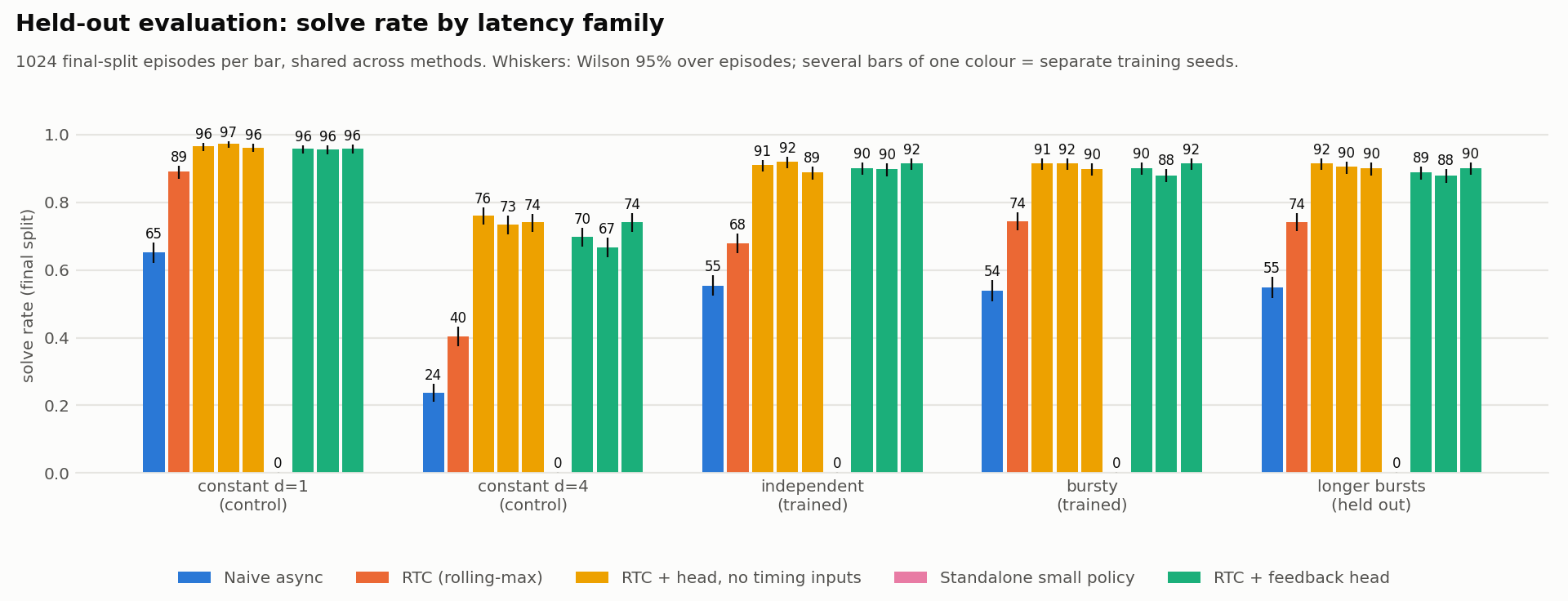
The head's corrections are small, about a fifth of their bound. The frozen policy still does the work. A head of the same size alone learns to dodge the hazard and never reaches the goal.
Timing inputs don't help
The head can see how old its plan is and how late recent plans were. A copy with those inputs zeroed does as well or better. I then registered a harder test in advance: hide the current state, so the head only sees the stale snapshot its plan came from. The timing head learned to rely on its timing inputs. It still tied the blind one (85.6% vs 85.6%). The claim failed.
Limits
- One simulated task, structured state, no hardware.
- No zero-delay control, so part of the gain may be general improvement.
- The head design is not new (A2C2, arXiv 2509.23224). What's new is how it behaves across delay patterns.
Built on RTC (Black, Galliker, Levine, arXiv 2506.07339) and Kinetix (arXiv 2410.23208).
Written with AI. I am using it for now to get moving, and I will shift to writing by hand.
Full report13 min · 4 tables · 3 figures
Protocol v2.0 (v1.0 results unchanged) · 2026-11-12/13 · simulated control with structured observations · one task · 3 training seeds per learned method · 1,024 evaluation episodes per cell
Summary
- A small RL-trained residual head on top of RTC recovers most of the performance lost to delay. On the held-out final split it solves about 90% of episodes under independent, bursty and never-trained longer-burst delays, against 68–74% for RTC alone and 54–55% for naive asynchronous execution (3 training seeds, 1,024 episodes per cell).
- It generalizes to the held-out longer-burst process with no visible loss (89–91%).
- Explicit timing inputs do not help. With a fresh state observation the timing-blind head is as good or slightly better in every family. In a second, pre-registered condition where the head only sees a stale snapshot (protocol v2.0), the two are again indistinguishable. "Learned temporal awareness" is not established; the registered claim rule failed on two of its three parts (see Snapshot-only).
- The frozen chunk policy is still doing the work. A same-size standalone controller trained on the same budget solves 0% (one seed: a pilot).
- The head architecture is not new (A2C2); what is measured here is its behaviour across latency processes under RL training, on one simulated task.
Question
A frozen action-chunk policy plans 8 control steps at a time and is re-queried every 4 steps. Its answer arrives 1 or 4 steps late, unpredictably, and sometimes in bursts. While the answer is late the world keeps moving and the controller keeps executing an ageing plan.
- Does a small RL-trained feedback head on top of inference-time RTC recover task performance?
- Does explicit timing information help beyond current state and the planned action?
- Does the behaviour survive a longer-burst latency process that was never trained on?
- Is the slow chunk policy still providing value, compared with a small standalone controller trained on the same budget?
Setup
- Task: Kinetix
catcher_v3(Kinetix-Symbolic-Continuous-v1), from the pinned upstream repo. A thruster craft with a jointed arm must bring the green ball to the blue ball without the green ball touching the red floor. Observation: 679-dim structured state vector (no pixels). Action: 6-dim continuous (4 motor dims in [−1, 1], 2 thruster dims in [0, 1]); this level uses 2 motors and 2 thrusters. Horizon: 256 control steps; measured mean episode length ≈ 68 steps. Upstream's action noise (σ = 0.1, added inside the env) is kept. - Reward: the original sparse task reward of upstream's evaluation env stack, +1 on goal contact, −1 on hazard contact, 0 otherwise; episode ends on either or at 256 steps. No shaping was added. (Upstream's expert-training script uses an extra distance penalty; it is not used here.)
- Base policy: the released flow-matching chunk policy for
catcher_v3(3.07M parameters, H = 8, 5 flow steps), hash-pinned, never updated. No training-time-RTC model and no new base policy were trained. - Runtime contract: query every s = 4 steps; a chunk launched at step t is indexed by absolute time t..t+7 and is withheld until t + d_true; on release execution continues at the index of the current step. One pending call suffices because d ≤ s. Startup follows upstream: a bootstrap chunk is available at t = 0 and query 0 launches on top of it. Delays outside 0..4 are rejected, not clamped.
- Latency families: delays are 1 (fast) or 4 (slow) control steps.
| family | process | role |
|---|---|---|
| const1 / const4 | always 1 / always 4 | runtime controls |
| independent | slow with p = .25 per query, i.i.d. | trained + evaluated |
| bursty | 2-state chain, fast→slow .05, slow→fast .15 | trained + evaluated |
| longer_bursts | fast→slow .025, slow→fast .075 | held out: never trained or tuned on |
The three random families share the marginal (25% slow, mean 1.75 steps) and differ only in temporal correlation (lag-1 autocorrelation 0 / 0.8 / 0.9).
- Splits: train, dev and final scenarios come from disjoint PRNG streams; each scenario has independent env-noise, policy-noise and latency streams, indexed by step / query so every method sees identical exogenous randomness and the identical delay trace.
Methods
| name | what it is | status |
|---|---|---|
naive | asynchronous chunk execution, fresh sample each query | baseline, measured |
rtc | inference-time RTC (guidance to the nominal prefix), d̂ = max of the last 4 completed delays, buffer initialised to 2, RTC's own rule | baseline, measured |
feedback | rtc + residual head: executed = clip(planned + α·tanh(head(x))) | learned, measured |
no_timing | same head, timing inputs zeroed | ablation |
standalone | same-size head that outputs the whole action; the chunk policy's plan is neither added nor shown | ablation |
Head: MLP 692 → 64 → 64 → 6 with tanh, 48,908 actor parameters (critic: separate MLP, 48,577). Inputs: current observation (679), planned action (6), plan age / 8, pending flag, elapsed pending time / 4, last four completed delays / 4. α = 20% of each dim's half-range = 0.2 (motors) and 0.1 (thrusters), fixed before training. The clip range is the action range widened to include the planned action, so a zero residual returns the plan bit for bit. The nominal chunk buffer is never overwritten with executed actions: RTC keeps conditioning on the nominal prefix, so exact prefix agreement is not claimed once feedback is on.
Training: PPO-clip with GAE, the loss and hyperparameters taken from upstream (γ .995, λ .9, clip .2, 4 epochs × 8 minibatches, Adam 3e-4, grad-clip 1); RPO's mean perturbation is switched off. 1,024 fresh training scenarios per update (independent / bursty, 50/50), 300 updates, final checkpoint, no checkpoint selection. The budget was fixed from the throughput benchmark before the first learned result.
Checks and compute
29 checks passed before the first training run (22 on CPU, 7 on GPU), covering the runtime contract, no leaked delay information, replay determinism, and agreement with the upstream evaluator. GPU runs are reproducible statistically, not bitwise: between two identical runs, 0.5% of episode outcomes flip and the solve rate moves by 0.3 points. Exact checks and replays ran on CPU.
Hardware: one RTX 5090, shared with another job. 13 training runs used 5.53 GPU-hours of a 6-hour cap. One run is 300 updates, about 21 minutes.
Held-out results
Final split, run once after all methods were frozen. Solve rate in %, per-seed values then the mean over training seeds. Each cell is 1,024 episodes; the Wilson 95% half-width of a single cell is about ±2 points (±3 near 50%).
| method | const1 (control) | const4 (control) | independent | bursty | longer bursts (held out) |
|---|---|---|---|---|---|
| naive | 65.1 | 23.6 | 55.4 | 53.9 | 54.9 |
| rtc | 89.0 | 40.3 | 67.9 | 74.4 | 74.2 |
| feedback (3 seeds) | 95.8 / 95.6 / 95.9 → 95.8 | 69.8 / 66.7 / 74.1 → 70.2 | 90.0 / 89.7 / 91.5 → 90.4 | 90.0 / 88.0 / 91.5 → 89.8 | 88.9 / 87.9 / 90.1 → 89.0 |
| no_timing (3 seeds) | 96.5 / 97.2 / 96.2 → 96.6 | 76.1 / 73.3 / 74.0 → 74.5 | 90.9 / 92.0 / 88.8 → 90.6 | 91.4 / 91.5 / 89.8 → 90.9 | 91.5 / 90.4 / 89.9 → 90.6 |
| standalone (1 seed, pilot) | 0.0 | 0.0 | 0.0 | 0.0 | 0.0 |
Answers to the four questions:
- Recovery: yes. Paired on identical scenarios, every head beats RTC in every family, and every 95% bootstrap interval excludes zero: +6.6 to +8.2 points at constant d = 1, +26 to +36 at constant d = 4, +21 to +24 under independent delays, +14 to +17 under bursty delays. For reference, upstream's no-delay solve rate for this policy is about 97% (GPU agreement gate), so the head closes most but not all of the gap.
- Timing inputs: no benefit (next section).
- Held-out longer bursts: yes. 89.0% (feedback) and 90.6% (no_timing) against 74.2% for RTC; the paired gain over RTC is +13.7 to +17.3 points per seed, the same size as on the trained bursty family.
- Standalone controller: fails on this budget. With the same network size, PPO settings and 300 updates but no access to the chunk policy's plan, it learns to avoid the hazard and time out (mean episode length 255 of 256, return ≈ 0) and never reaches the goal. One seed, so a pilot; a longer budget or a shaped reward might change it, neither was tried.
Zero incomplete episodes and zero runtime violations in all 45 cells. The head's corrections are small: mean |residual| ≈ 0.03–0.04 in action units (the bound is 0.2 / 0.1), no saturated dimensions, the action-range clip active on 6–9% of dimension-steps.
Training curves (dev split, 256 fixed episodes per point, deterministic head):
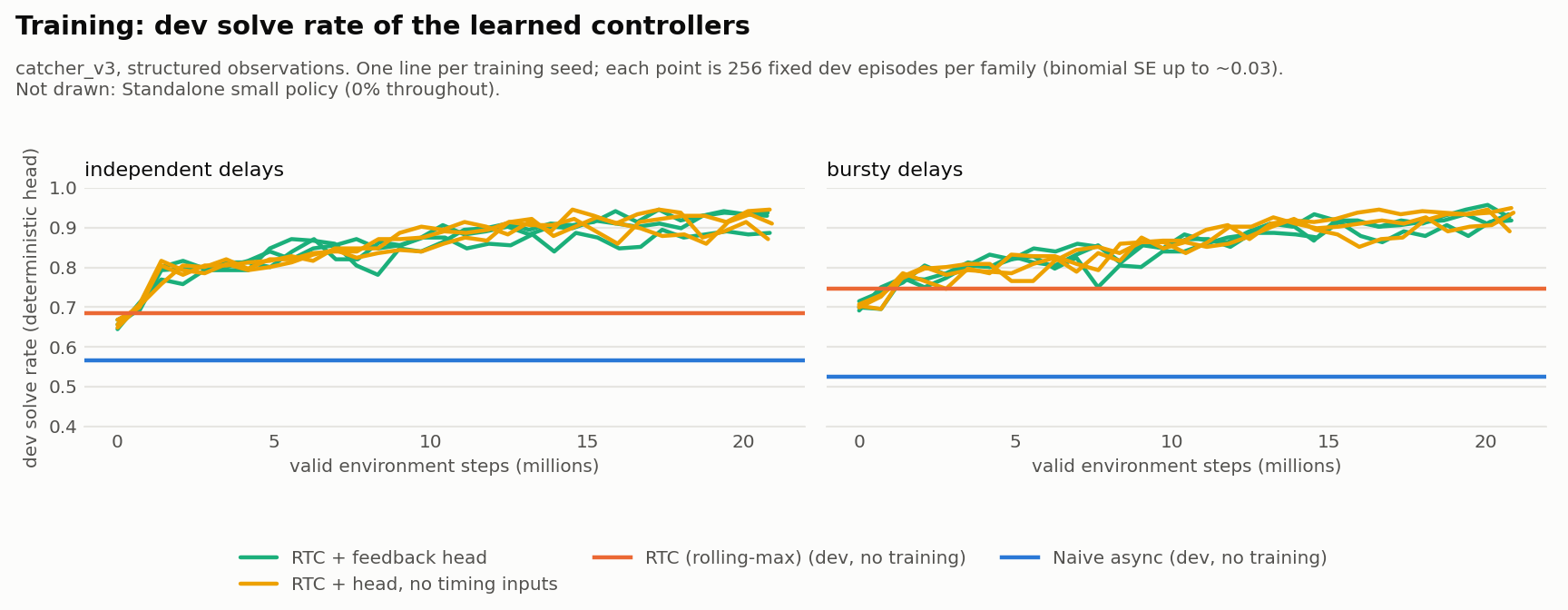
Spread across training seeds is 1–3 points in the random families and up to 7 at constant d = 4. With three seeds this is a range, not a confidence interval. The intervals quoted above are over evaluation episodes for a fixed trained head.
A metric detail inherited from upstream. "Solved" is upstream's flag: goal contact on the last physics substep of the terminal control step. Reward is the max over the two substeps. In 1.6% of final-split episodes (1.1–2.0% depending on method) the return is +1 but the flag is false, and about half of unsolved episodes end with return 0 rather than −1. The flag is used unchanged for every method, so comparisons are unaffected; replays label such an episode "GOAL HIT, not counted".
Do timing inputs help?
No. Mean over seeds, feedback − no_timing: −0.8 (const1), −4.3 (const4), −0.2 (independent), −1.1 (bursty), −1.6 (longer bursts). Of the fifteen seed-matched cells (3 seeds × 5 families), one shows a gain whose paired 95% interval excludes zero (seed 2, independent, +2.7) and five show a loss that does, including two of the three pairs at constant d = 4.
Exploratory dev-split check of whether the heads use the inputs: the timing fields are replaced at test time with zeros, with "everything is fresh", with "everything is stale", or with another episode's values. One timing head barely moves (bursty 92.3% → 91.5–92.1%, except 86.2% under "stale"); another depends on them strongly (91.0% → 83.7% when zeroed; const4 71.1% → 46.8%). So some heads learn to read the inputs, but reading them buys nothing over the timing-blind head.
My interpretation, not a measurement: the head sees the current full simulator state every step. Given that state and the planned action, the best correction does not depend on how old the plan is, so the timing inputs are redundant by construction in this condition.
Snapshot-only test, registered before training
To give timing a chance to matter, protocol v2.0 removes the head's own sensor path: it sees only the observation its active chunk was computed from, which is 1–7 steps old. Everything else is unchanged. The condition, its two methods, the hypothesis and the following rule were written down before any such head was trained:
"Learned temporal awareness" may be claimed only if ALL hold on the final split: (a) mean over 3 training seeds of solve rate is higher for sync_feedback than sync_no_timing by >= 3 points on bursty AND on held-out longer_bursts; (b) all three seed-matched pairs have a positive difference on longer_bursts; (c) on dev, replacing the timing inputs of sync_feedback heads with wrong values at test time lowers solve rate. Anything less is reported as not established.
Final split:
| method | const1 | const4 | independent | bursty | longer bursts (held out) |
|---|---|---|---|---|---|
| rtc (same scenarios, re-run) | 88.8 | 40.6 | 68.0 | 74.1 | 74.2 |
| sync_no_timing (3 seeds) | 94.6 / 95.4 / 94.5 → 94.9 | 52.4 / 54.3 / 58.2 → 55.0 | 85.0 / 86.3 / 86.2 → 85.8 | 84.6 / 86.0 / 86.2 → 85.6 | 84.4 / 84.0 / 85.6 → 84.7 |
| sync_feedback (3 seeds) | 94.7 / 95.7 / 93.8 → 94.7 | 58.0 / 51.3 / 57.7 → 55.7 | 86.1 / 84.7 / 86.5 → 85.8 | 86.5 / 83.8 / 86.4 → 85.6 | 86.0 / 83.1 / 86.3 → 85.2 |
| seed-matched difference s0 / s1 / s2 | +0.1 / +0.3 / −0.8 | +5.6 / −3.0 / −0.5 | +1.2 / −1.7 / +0.3 | +2.0 / −2.2 / +0.2 | +1.7 / −0.9 / +0.7 |
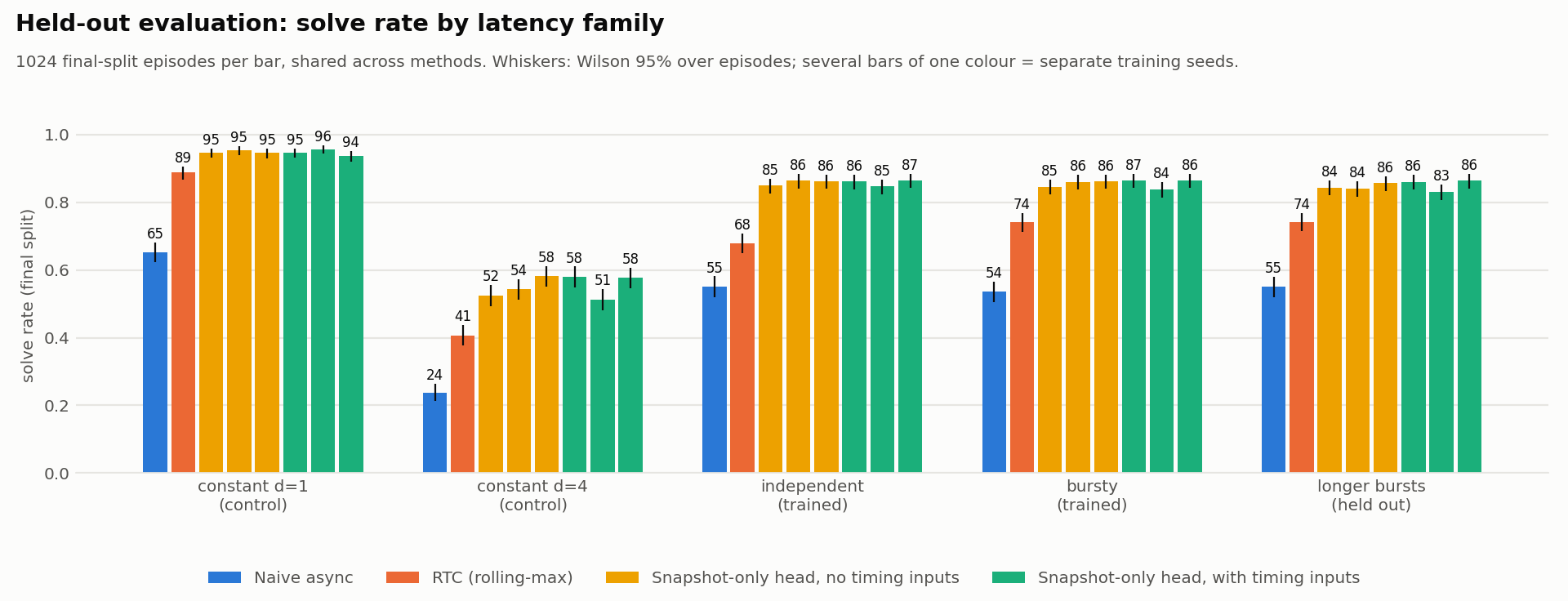
Verdict on the registered rule: not established.
- (a) Fails. Mean difference is −0.0 points on bursty and +0.5 on longer bursts; the bar was +3 on both.
- (b) Fails. The seed-1 pair is negative on longer bursts (−0.9).
- (c) Holds. On dev, zeroing the timing inputs lowers every sync_feedback head: bursty 87.7 → 82.9, 83.4 → 79.8, 87.0 → 80.9; const4 63.3 → 44.1, 56.3 → 41.6, 63.5 → 39.4. Telling the head "everything is fresh" does the same. Telling it "everything is stale" lowers one head on bursty (87.7 → 81.4) and raises the other two (83.4 → 85.8, 87.0 → 90.1).
So under a stale snapshot the heads with timing inputs do come to rely on them, far more than in v1, but a head trained without them reaches the same solve rate. Use is shown; benefit is not. Two further observations:
- The snapshot-only heads still beat RTC by about +11 points on bursty and longer bursts and +14 to +15 at constant d = 4, so stale feedback remains useful; it costs 5–6 points against the fresh-state heads in the random families and 15–20 at constant d = 4.
- Exploratory, dev only, two heads: v1 heads evaluated zero-shot on stale snapshots scored 88.9% and 86.7% on bursty, about the same as heads trained in that condition (83.4–87.7% on the same dev scenarios). Training on the stale view did not visibly improve on a head trained with fresh state.
Disclosures: the final split had already been used once for the v1 evaluation, and v2 was evaluated on the same scenarios. The plan_sync channel was implemented before the v1 final numbers were seen, but v2.0 and its claim rule were registered after: the v1 final summary was written at about 04:22 UTC on 2026-11-13 and v2.0 at about 04:35 UTC, before any snapshot-only head was trained. An earlier candidate condition (stalled: observation frozen only while a call is pending, at most 3 steps stale) was dropped after a zero-shot dev check showed no loss, and was never trained on.
Other diagnostics (dev split, exploratory)
- RTC's delay estimate. Solve rate of RTC alone on independent / bursty delays with different estimates of the next delay: rolling max (RTC's rule) 68.6 / 74.6, last delay 73.1 / 77.0, always 1: 75.6 / 75.0, always 4: 65.8 / 65.1, oracle (true delay, evaluator-only) 80.6 / 78.0. Even a perfect delay estimate leaves RTC about 12–15 points below the feedback heads on the same dev scenarios, and the conservative rolling max is not the best simple rule here.
- What the head responds to (one head, 384 dev bursty episodes on CPU, Wilson half-widths about ±3–4 points). Unmodified head 93.2%; head output replaced by its own average (a fixed bias) 77.3%, which is about RTC alone (74.7% on the dev split); output replaced by its average at each time step (an open-loop schedule) 86.2%; observation taken from another episode 81.5%; planned-action input taken from another episode 89.6%. So a constant offset explains almost none of the gain, a time-indexed open-loop correction explains roughly 60% of it, and the rest needs the actual state.
- Residual size by plan age: in v1 the mean correction is 0.15–0.22 of the bound and nearly flat in plan age; in v2 one head (seed 0) corrects three times less on a brand-new plan (0.05) than on an older one (0.16).
Limits
- Not established: any benefit from timing inputs, in either observation condition.
- Failed run kept: the standalone controller (0% everywhere).
- Single seed: the standalone ablation. Everything else has three training seeds, which gives a range, not an interval, across seeds.
- One task, one base policy, one simulator, structured state, simulated delays of 1 or 4 control steps with d ≤ s. Nothing here was run on hardware or from pixels.
- No zero-delay control. The head was never evaluated at d = 0, so "compensates for delay" cannot be separated from "improves the policy in general"; it also gains +6.6 to +8.2 points at constant d = 1, the smallest delay tested.
- Not done: rerunning A2C2 under this protocol; a training-time-RTC base policy; delays longer than the query interval or the chunk horizon; other Kinetix tasks; checkpoint selection or hyperparameter tuning (upstream's PPO settings were used as they are, and α was fixed before training); a snapshot-only standalone controller.
- GPU nondeterminism: GPU numbers are reproducible statistically, not bitwise. The RTC row differs by up to 0.3 points between the v1 and v2 evaluations of the same scenarios.
- Reused final split for v2 and part of the GPU time log was entered by hand.
- One timing-blind head (seed 2) was trained after a code revision that added optional diagnostics. The registered behaviour is unchanged and the CPU checks were re-run on that code.
Next (not done)
The two conditions tested share a property: the delay never outlasts the plan (d ≤ s < H), and a timing-blind head can infer how stale things are from the state and the plan it is shown. Regimes where that inference is not available are the ones where a timing signal could carry information: outages longer than the chunk horizon, a task where the right action under a late plan is to wait rather than correct, or giving the delay estimate to the planner (the oracle result above puts a ceiling of roughly +3 to +12 points on that for RTC alone). Each needs a new protocol version.
Credits and prior work
- RTC (Black, Galliker, Levine, arXiv 2506.07339; training-time variant arXiv 2512.05964): base policy, inference-time guidance, rolling-max delay estimate, evaluator, checkpoints.
- A2C2 (arXiv 2509.23224): a small per-step correction head on a chunk policy. The head here is an RL-trained variant studied across latency processes. The architecture is not new. A2C2 was not rerun under this protocol; no comparison with its published numbers is made.
- Kinetix (Matthews et al., arXiv 2410.23208): simulator and task.