The world moves while the model thinks
AI tests pause the world while the model thinks. Real work doesn't. When the clock kept running, every model I tested scored below zero.
- Question
- Does a model plan for the time its own reply takes?
- Result
- Mostly no. Plans allow 0 to 2 ticks for replies that cost 6 to 11.
Same model, same 12 items. On the left the belt waits while it thinks: 12 of 12. On the right the belt keeps moving: 2 of 12.
Why
Almost every AI test stops the world while the model thinks. The model can take ten seconds or ten minutes and the test waits.
Real work doesn't wait. A robot arm, a voice call, and a live web page all keep moving while the reply is being written. An answer that was right when the model started can be wrong by the time it lands.
So the question is simple. Does a model plan for the time its own reply takes? If it doesn't, it can't run anything in real time, however smart it is. With several agents the problem grows, because each one acts on a picture the others may have already changed.
Backburner is the smallest environment I could build where that is the only hard part.
Setup
One cook, three burners, twelve tickets. A reply is a list of timed actions. The clock moves one tick per N tokens the model writes, reasoning included, and the reply runs at the tick it lands. A dish served before it is done is thrown away, so acting on a stale picture scores worse than doing nothing.
Each model plays the same seeds on three clocks: paused, a fixed stated delay, and its own reply length. A script charged the model's own reply sizes sets the bar.
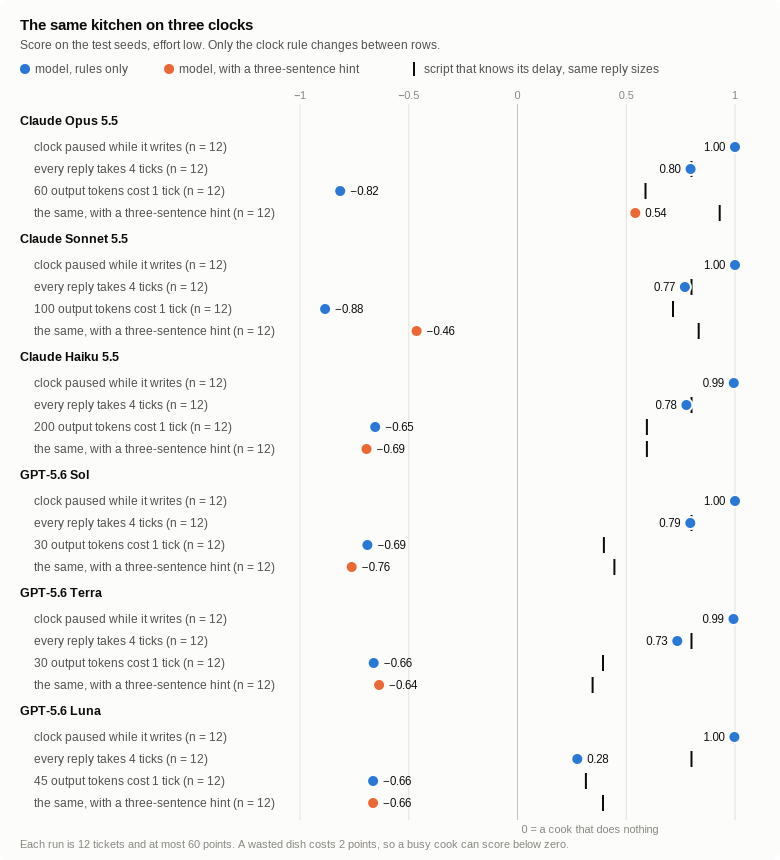
Result
- Paused, every model scores 0.99 to 1.00.
- Told "every reply takes 4 ticks", most plan for it: 0.73 to 0.80, where the script gets 0.80.
- On their own clock, all seven models go below zero. Opus scores -0.82 and serves 11 of 144 tickets. A script with the same reply sizes scores 0.59.
The models do allow for a delay, just not enough. The median plan allows 0 to 2 ticks. The median reply costs 6 to 11. Every reply comes with a receipt saying how late the last one landed. Nothing changes. After the first lost dish, the replies get longer, on the one clock where length is the cost.
Three sentences of advice in the prompt lifted Opus from -0.82 to 0.54. It did not help Haiku or any GPT model.
Can it be learned?
I trained a small adapter on a 27B local model to imitate a script. It learned short replies and a one-tick lead. That carried to the belt, a task it never saw, where it scores 1.00. It did not learn to plan for a reply that spans several ticks: 0.10 to 0.39 there, against 0.51 to 0.84 for the script. It learned a usual delay. It never learned to count what it was about to write.
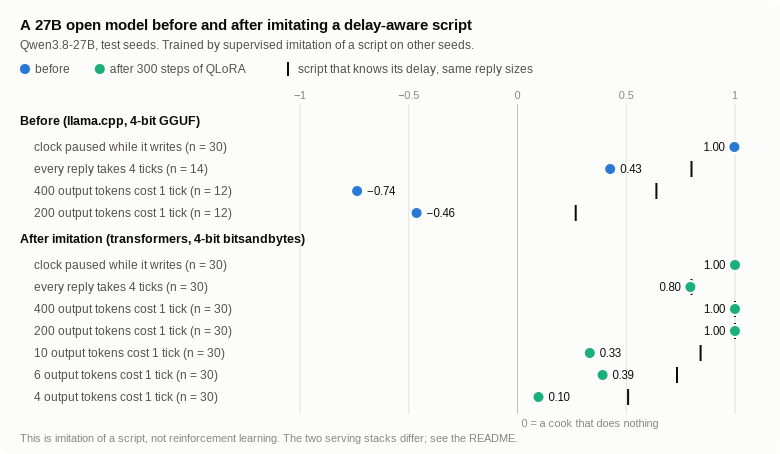
That gap is what this environment is for.
Limits
- Pilot. 12 seeds per cell, one run per seed, one prompt.
- No robot. The belt is a simulation.
- One rule carries the loss: a dish served early is thrown away and nothing can be cancelled.
- On the belt, Opus and Sonnet did not fail (0.96 and 0.78). So it is not a fixed trait of a model.
Prior work: Real-Time Reasoning Gym (arXiv 2511.04898) and Realtime-Bench (arXiv 2610.22155) also charge models for thinking time. Real-time chunking (arXiv 2506.07339) solves the same problem inside robot controllers.
Written with AI. I am using it for now to get moving, and I will shift to writing by hand.
Full report27 min · 4 tables · 4 figures
The question
Most evaluations stop the world while the model thinks. Deployed agents don't get that. Pages change and queues move while the model is still writing. I wanted the smallest environment where that is the only hard part, with enough controls to check that it really is.
The environment
One cook, three burners, twelve tickets. A reply is a list of timed actions. The clock moves one tick per N output tokens, reasoning included, and the reply is read at the tick it arrives. A ticket pays more the sooner it is served. A dish served before it is done, or never served, costs points, so a cook who does nothing scores zero and a cook who acts on a stale picture of the kitchen scores less than that.
The model is told the rate. With every view of the kitchen it also gets a receipt for each recent reply: tokens used, ticks taken, how many of its actions were already overdue on arrival. Nothing is hidden except the tickets still to come. One number, tokens per tick, sets the difficulty.
The skill being tested: plan for the tick the reply will land on, and keep the reply short enough that this tick is close.
Why it matters
The assumption. A benchmark that pauses the world scores the answer. It cannot score whether the answer was still true when it arrived. That was a fair simplification for question answering. It is not one for an agent that acts.
Where it bites. Agents are being put on live web pages, in voice, in operations, and in planning for robots. In all of these the time a reply takes is part of the action. The common way to make a model better at a hard task is to let it reason for longer, which a paused benchmark rewards and a moving world charges for. Robot learning already treats this as a named problem, inference delay: a policy's actions are computed from an observation that is old by the time they run, and methods such as real-time chunking (Black, Galliker and Levine, arXiv 2506.07339) plan around the delay inside the controller.
Why build an environment for it. The fault is narrow and exact to measure, so it is something to train on and not only a test. The reward is computed from the journal, every episode replays, and scripted players give a bar at each delay.
All of this rests on a pilot: two small simulated tasks, 6 to 30 seeds per setting, one run per seed, and no robot.
Four design decisions
1. Three clocks on the same seeds. Paused; a delay that is stated and the same every time; and the token clock. If a model is perfect on the first, fine on the second and fails on the third, the problem isn't cooking and it isn't delays in general. It is the model's own delay.
2. The bar is a script that pays the same time. Each scripted cook is replayed on the same seeds and charged reply sizes drawn at random from the model's own replies in that cell. The model and the script lose the same ticks to writing, so the gap between them is not typing speed. The reference script knows one thing only: how long its reply will take. The sizes are not matched to the seed or to the point in the run, and the script is told each size before it plans, which a model is not.
3. Attack the scorer, and publish what the attacks found. The controls are scripted cooks with pass-or-fail gates, such as "a cook that does nothing scores zero" and "no cook that ignores the tickets comes near the reference script". On top of them a reviewer, a separate language-model session given the code and no model calls, wrote scripts that try to score without the skill. Each pass found something. Five came before the model runs and each led to a rules change. One came after the runs were paid for and found that two of my gates were false: a cook that reads no ticket, cooking every dish on a timer, scores about 0.5, where I had claimed a floor of 0.19. The runs could not be repeated within the budget, so the rules stayed. The timer cook is now a named control, and the model results do not lean on the hole: 11 of 4,784 served tickets used a dish started before its ticket appeared.
4. Every episode replays. A journal holds the seed, each reply and its token count. A checker recomputes the run from those. Tables are built only from journals that replay.
What the models do
Three Claude models (Opus 5.5, Sonnet 5.5 and Haiku 5.5, effort low, 12 test seeds per cell) and a local Qwen3.8-27B (12 to 30 seeds per cell) all play the paused kitchen at 0.99 to 1.00. Told that every reply takes 4 ticks, the Claude models score 0.77 to 0.80, at or just under the script's 0.80.
When the delay is their own reply length, every model scores below zero: Opus -0.82, Sonnet -0.88, Haiku -0.65, Qwen -0.74. All 72 Claude runs on the token clock without the hint are below zero. With the same reply sizes the reference script scores 0.59, 0.72 and 0.60, and even the cook that reads no ticket scores 0.36 to 0.44. Opus serves 11 of 144 tickets and throws 312 dishes away, and nine in ten of its replies arrive with actions already overdue.
Three GPT-5.6 models (Sol, Terra and Luna), run last on 12 other seeds, repeat it. Their rates were set at 0.6 times each model's median paused reply, the ratio the Claude rates turned out to have. They score 0.99 to 1.00 paused and -0.66 to -0.69 on the token clock, with 36 of 36 runs below zero, the same first lost dish in every run and replies that grow 3.5 to 5.5 times. The hint does not help them. Their rates are harder in ticks, and there the reference script scores only 0.31 to 0.40.
There is a complication, and I think it is the most useful thing in the data. Under the first version of the rules the three Claude models passed this clock at the same rates, serving 82 to 89% of tickets. They made the same planning mistake then: in all 90 of those runs a reply arrived with an action already overdue. It cost nothing, because a wasted dish was free and a serve on a dish that was not done did nothing. The review passes closed those two holes, and that is what turned a pass into a failure.
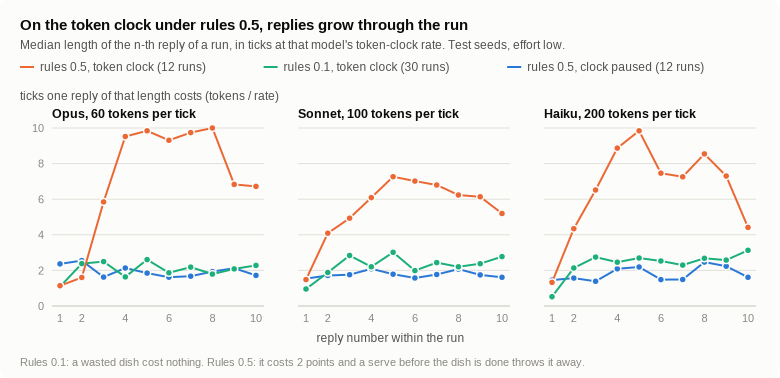
Under the current rules the first mistake is small. The first reply is short (a median of 69 tokens for Opus) and lands two ticks after the ask, so the cook starts late and the serve planned for the old finishing tick throws the dish away. That is the first dish lost in 72 of 72 runs. Then the replies grow: from the third reply on Opus writes a median of 499 tokens, 9 ticks each, where with the clock paused or the delay stated its later replies stay about the length of its first. The journals show when the replies grow, not why. Haiku's replies grew under the old rules as well, on every clock including the paused one, so only for Opus and Sonnet is the growth tied to this clock.
The plans do allow for a delay, only nowhere near enough. Take the gap between the tick a model was asked and the earliest tick in its plan as what it allowed for its own reply. In all seven cells the median allowance is 0 to 2 ticks, and the median reply cost 6 to 11. Of the 796 replies with a readable plan, 16 allowed at least what the reply went on to cost. Haiku, Luna and Qwen plan from the tick they were asked in 34 of their 36 first replies; Opus, Sonnet, Sol and Terra usually add a tick and do so in only 8 of 48. A receipt reports the miss after every reply and nothing changes: the share of replies that arrive with actions overdue is 89 to 100% in the first third of a run and 95 to 100% in the last. The loss also has one form. Of the 1,928 dishes lost in these 84 runs, 1,927 were served before they were done.
So the claim is narrower than "models cannot plan around their own latency". They know a reply takes time and allow a tick or two for it. After the first lost dish their replies get longer, on the one clock where a longer reply is the cause. A slower clock did not score lower, either: each model scored higher at half the rate (Opus -0.50 against -0.82), where it took fewer turns (91 replies against 139) and so threw fewer dishes away. Below zero, the score mostly counts activity.
A version with a shell and a real clock gave the same picture in two single runs: a stock agent driving the local model scored 1.0 with the clock paused and -0.33 at ten seconds per tick. Its plans took a median of 7 ticks to arrive, and 10 of its 12 readable plans arrived with actions already overdue.
Is it only the prompt?
I added three sentences of advice to the rules: the plan is read when the reply arrives, keep the whole reply short, plan from the arrival tick. Opus went from -0.82 to 0.54 (95% interval over seeds 0.24 to 0.81) with replies six times shorter. The gain is large but unreliable: 3 of 12 runs were still below zero, and the mean is 0.31 under a script that ignores its delay at the same reply sizes. Sonnet moved from -0.88 to -0.46 and stayed below zero. Haiku did not move (-0.65 to -0.69) and its replies did not get shorter. The hint bundles three instructions, so which one matters is not known.
Can it be learned?
I fitted a rank-16 QLoRA adapter on the local 27B model to 2,400 replies of a teacher script, 300 steps, and tested it on seeds it never saw. The cooking and the reply format were learned: 1.00 with the clock paused and wherever a reply costs one tick, 0.80 at a stated 4 ticks, with replies of a median 31 tokens where the base model's medians were 336 to 3,064.
The timing was not. Where its own reply spans 4 to 8 ticks it scores 0.33, 0.39 and 0.10, against 0.84, 0.73 and 0.51 for the reference script, and below a cook that reads no ticket (0.41 to 0.48). Those rates lie inside the range it was trained on. The journals say why. At 10 tokens per tick, 104 of 377 replies were planned for a tick earlier than the one they landed on, and 55 of those were replies one action longer than usual, planned as if they were the usual length. The adapter learned a usual delay for each clock. It did not learn to count what it was about to write. A teacher that leaves a tick of margin might fix that by imitation alone, which is cheaper to test than reinforcement learning and should come first. Neither has been run.
Does it hold on a second task?
The kitchen is one game, and its loss rests on one rule about wasted dishes. So I wrote a second, plainer task on the same clock: a gripper over a conveyor belt with six lanes. Items move one cell per tick, a grab picks an item only if it names the lane and cell the item is in at the tick the grab runs, and a grab on nothing costs points. The right action depends on the tick the reply lands at and on nothing else. It is the closest thing here to the robot-control form of the problem, inference delay, and it is still a simulation: no robot and no robot policy was tested. Before any model played, a reviewer attacked the first two versions of the scoring and each had a hole. The third, which the models ran on, passed the same attacks.
The base local model fails the belt the way it fails the kitchen. Paused, it picks 144 of 144 items. On the token clock it picks 21 of 288 and all 24 runs are below zero (-1.23 and -0.68, where the script that knows its delay scores 0.79 and 0.43). Its plans allowed one tick for replies that took 5 and 10, and 710 of its 718 grabs on nothing were aimed at the cell an item was in at the tick the grab was planned for, and ran after it had moved on.
Three GPT-5.6 models do the same, at the token rates of their kitchen runs. Paused, they pick 360 of 360 items. On the token clock they score -0.87, -0.89 and -1.19; all 30 runs are below zero and 25 of 360 items are picked, where the script that knows its delay scores 0.51 to 0.71. All 329 of their plans allowed less time than the reply took. Two things to hold against this: one of GPT-5.6 Luna's 12 paused runs scored below zero, because it guessed at every lane while the belt was empty, so its paused score is 0.80; and to stay inside $3 the largest model played 6 seeds and none of the three was run with a stated delay.
Three Claude models, run last at their kitchen rates, split. Haiku fails as it does in the kitchen: -0.76, 22 of 144 items, all 12 runs below zero, with replies that cost a median of 8 ticks and plans that allowed 2. Opus and Sonnet do not fail: 0.96 and 0.78, 144 and 134 of 144 items, one Sonnet run below zero. Their replies stay at 2 ticks and their plans aim 3 and 2 ticks ahead, where in the kitchen their first plan allowed about one tick for a reply that took two. Sonnet's two bad runs are the kitchen's pattern in small: after misses its replies grew to 5 to 6 ticks. Told a delay of 4 ticks, all three score the script's 0.80. This needs care in both directions. At a reply cost of 2 ticks the belt is easy (a fixed lead of 3 scores 0.97 and 0.92 against 0.99 and 0.98 for the script), so these runs show two models staying out of the failure, not planning for a long delay, and no rate where their replies span 4 ticks or more was run. But they do show that the failure is not a fixed property of a model: the same two models on the same clock fail one task and not the other, and the journals do not say why.
Then the transfer test. The adapter trained on kitchen replies only, which has never seen a belt, scores 1.00 at those two rates. A script that plans as if replies were instant scores -1.76 there, so short replies alone do not earn that; every one of its 288 plans allowed the one tick the reply cost. A fixed habit of aiming one tick ahead would score the same there, so this shows that a one-tick lead carried over, not that a forecast did. Where its reply spans 3 to 7 ticks it scores 0.53, 0.21 and -0.19, against 0.94, 0.77 and 0.54 for the script, and for the reason found in the kitchen: plans with one grab were planned short 34 times in 274, plans with two or more 99 times in 139. So both halves carried over to the second task: what the adapter had learned, and what it had not. This is one adapter, 12 seeds per cell, and a second task that shares the kitchen's clock and reply format.
Difficulty
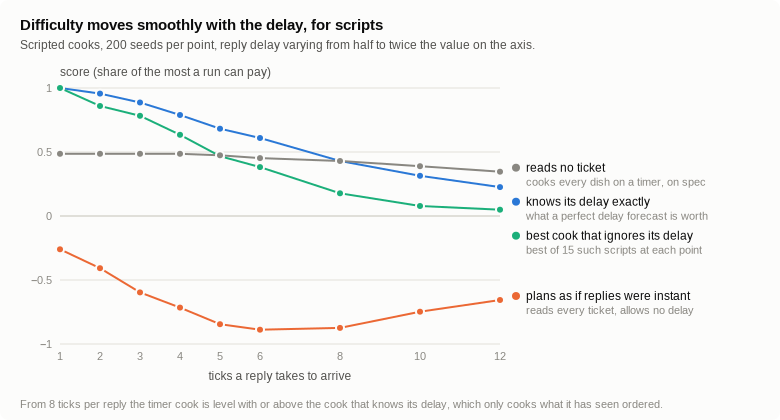
For scripts the difficulty moves smoothly with the delay: the cook that knows its delay goes from 1.00 at one tick per reply to 0.23 at twelve, and over delays of 1 to 8 ticks it is ahead of the best fixed habit by 0.19 (95% interval 0.17 to 0.20). It is not a ceiling at the far end: from 8 ticks per reply the timer cook, which gambles on what will be ordered, catches it. For models a smooth dial is not shown: the two rates tried per Claude model came out in the wrong order.
Nearest prior work
The idea of charging a model for its thinking time is not mine. Real-Time Reasoning Gym (Wen et al., arXiv 2511.04898) uses token count as world time and includes an Overcooked task; it proposes an inference-time method, and I found no training results in it. Realtime-Bench (Tang et al., arXiv 2610.22155) compares paused, wall and token clocks on web tasks and games, which is the same three-way comparison as the first design decision above. Gaia2 (Froger et al., arXiv 2602.11964) keeps its clock moving while the agent responds. Robot learning calls the same problem inference delay: real-time chunking (Black, Galliker and Levine, arXiv 2506.07339) plans around it for action-chunking policies by fixing the actions that will run before the next chunk is ready and generating only the rest, which is the kitchen's "plan from the tick you land on" in a controller.
What this work adds is narrower. As far as the abstracts and the parts of the text I checked show (2026-11-17), those papers do not have: a delay that is stated and fixed as a second control; scripted cooks charged the model's own reply sizes as the bar; a receipt after every reply telling the model how late it was; a clock this fine (4 to 400 tokens per tick); the comparison of the delay a plan allows with the delay the reply cost; or a record of the attacks on the scorer. This work does not run their code, and no model here was tested on their tasks.
A separate controller experiment of mine, Lagtime, tested the control side of the same problem using real-time chunking's released policy. There the delay came from a sampler and the plan could be corrected after it was made. A language model's delay is set by its own reply, and nothing corrects a plan once it is sent. So Lagtime is a related result, not evidence for the results here.
What I would not claim
- One rule carries the whole loss: a serve on a dish that is not done throws it away, and nothing scheduled can be cancelled. Under the first rules, where that serve did nothing, the same models passed. A plan format with "serve when done" would remove the failure and the test with it. The result is about open-loop plans with actions that cannot be undone.
- It is not that models always ignore their own delay. On the belt Opus and Sonnet left a margin and scored 0.96 and 0.78, at a reply cost of 2 ticks. On an earlier, plainer task with the same clock (three Claude models, 6 seeds), where a late move is dropped and not run, Opus cleared 60 of 60 gates at 100 tokens per tick and Sonnet 57, level with a script that forecasts its delay, and Opus allowed a median of 9 ticks. Both fell to the level of a script that ignores its delay at 35 tokens per tick. Why Opus leaves a margin there and not in the kitchen was not looked into.
- The stated-delay control differs from the token clock in more than one way. The delay is stated, constant, not caused by the reply, and 4 ticks where the models' own replies took a median of 6 to 13. No stated delay of 8 to 10 ticks was run, so "their own delay" is the reading I think fits best, not one the controls isolate.
- The bar is a script told its reply size before it plans. A script that has to forecast it from receipts, as a model does, scores 0.26, 0.46 and 0.28 in the Opus, Sonnet and Haiku cells and about zero in the GPT cells, and on the first reply there is no receipt to forecast from.
- The robot arm in the kitchen demo is a drawing, and the belt is a simulation with a gripper that reaches any lane and cell at once. No robot and no robot policy was tested.
- These are pilots: 12 seeds per Claude cell, one run per seed, one prompt, one effort setting, sampling at provider defaults. The rules were revised between versions with results on the same seeds in view, and no analysis was fixed in advance.
- The skill is tested in two small games of mine that share a clock and a reply format. The belt was played by one local model, its adapter, three GPT-5.6 models and three Claude models. Transfer to an unrelated task was not measured.
- Rules 0.5 pay for cooking before the ticket shows, so about 0.5, not zero, is what a model must clear to show it reads the tickets, and at long delays the reference script is not the best policy.
- The game does not separate "forecast your delay from past replies" from "use a good fixed habit": with a varying delay those two score the same (0.56 and 0.58). What the game rewards is controlling your own reply length and planning for the length you chose.
- A model can score well by writing very little. That is the intended solution, and it also means the token clock rewards terseness as such.
- The trained model imitates a script that already knows the trick and did not learn the timing. The base and adapted models were served by different stacks.
- Token rates were set per model, so scores are not comparable across models.
What I would do next
- Imitation with a margin, then the score. First the cheap test: a teacher that leaves a tick of margin and writes replies of varied length. If the gap at 4 to 10 tokens per tick stays (imitation 0.10 to 0.39, reference script 0.51 to 0.84), train on the score. The code already emits one trace per reply with the run's reward and the reward still to come.
- Rules 0.6. Make dishes to order (a dish can only serve a ticket that was showing when it was started), which cuts the best no-ticket cook from about 0.5 to about 0.37 in simulation, then rerun the controls, another attack pass on the scoring, and the model rows.
- Separate the two failures. Cap the reply length, or tell the model its usual length, to see how much of the score is the first mistimed plan and how much is the growth after it.
- Transfer, further out. The adapter trained on the kitchen was tested on the belt, a near neighbour. Next: Opus and Sonnet on the belt at a rate where their replies span four ticks or more, a task that does not share the reply format, and a belt with reach time and sensing noise, where a late grab and an imprecise one can be told apart.
- Variance and memory. Repeat runs on the same seed, and play the Claude models with their own earlier replies in view, to see whether the receipts alone are what they fail to use. The local model has had one such run (12 seeds): it scored 0.15 above its stateless run, -0.63 against -0.78, with shorter replies and more tickets served, and its plans still started at the tick it was asked at.
How this was made
Much of the code, the attack scripts, the analysis and drafts of this text were written with an AI coding assistant (Claude Code) under my direction. The reviewer sessions named above were separate language-model sessions with no access to model runs.
All results
One row per model and clock; built from episode journals that replay.
Kitchen
| Model | Clock | Runs | Score | 95% interval over seeds | Runs below zero | Tickets served | Dishes wasted | Tokens per reply (median) | Ticks per reply (median) | Replies not readable |
|---|---|---|---|---|---|---|---|---|---|---|
| Claude Opus 5.5 | paused | 12 | 1.00 | 1.00 to 1.00 | 0 | 144 of 144 | 0 | 100 | 0 | 0 of 199 |
| Claude Opus 5.5 | every reply 4 ticks | 12 | 0.80 | 0.79 to 0.80 | 0 | 144 of 144 | 0 | 187 | 4 | 1 of 191 |
| Claude Opus 5.5 | 60 tokens per tick | 12 | -0.82 | -0.87 to -0.76 | 12 | 11 of 144 | 312 | 430 | 8 | 0 of 139 |
| Claude Opus 5.5 | 60 tokens per tick, with the hint | 12 | 0.54 | 0.24 to 0.81 | 3 | 120 of 144 | 88 | 68 | 2 | 0 of 192 |
| Claude Opus 5.5 | 30 tokens per tick | 12 | -0.50 | -0.58 to -0.41 | 12 | 5 of 144 | 191 | 361 | 13 | 0 of 91 |
| Claude Sonnet 5.5 | paused | 12 | 1.00 | 1.00 to 1.00 | 0 | 144 of 144 | 0 | 161 | 0 | 0 of 199 |
| Claude Sonnet 5.5 | every reply 4 ticks | 12 | 0.77 | 0.72 to 0.80 | 0 | 144 of 144 | 6 | 305 | 4 | 0 of 191 |
| Claude Sonnet 5.5 | 100 tokens per tick | 12 | -0.88 | -1.00 to -0.74 | 12 | 35 of 144 | 347 | 541 | 6 | 0 of 166 |
| Claude Sonnet 5.5 | 100 tokens per tick, with the hint | 12 | -0.46 | -0.68 to -0.17 | 11 | 75 of 144 | 277 | 356 | 4 | 0 of 181 |
| Claude Sonnet 5.5 | 50 tokens per tick | 12 | -0.72 | -0.75 to -0.68 | 12 | 3 of 144 | 259 | 484 | 10 | 0 of 114 |
| Claude Haiku 5.5 | paused | 12 | 0.99 | 0.98 to 1.00 | 0 | 144 of 144 | 2 | 297 | 0 | 0 of 199 |
| Claude Haiku 5.5 | every reply 4 ticks | 12 | 0.78 | 0.76 to 0.79 | 0 | 144 of 144 | 5 | 696 | 4 | 0 of 191 |
| Claude Haiku 5.5 | 200 tokens per tick | 12 | -0.65 | -0.74 to -0.56 | 12 | 35 of 144 | 266 | 1271 | 7 | 0 of 148 |
| Claude Haiku 5.5 | 200 tokens per tick, with the hint | 12 | -0.69 | -0.79 to -0.60 | 12 | 29 of 144 | 272 | 1359 | 7 | 0 of 147 |
| Claude Haiku 5.5 | 100 tokens per tick | 12 | -0.48 | -0.50 to -0.45 | 12 | 2 of 144 | 173 | 1213.5 | 12.5 | 0 of 86 |
| GPT-5.6 Sol | paused | 12 | 1.00 | 1.00 to 1.00 | 0 | 144 of 144 | 0 | 50 | 0 | 0 of 202 |
| GPT-5.6 Sol | every reply 4 ticks | 12 | 0.79 | 0.78 to 0.80 | 0 | 144 of 144 | 1 | 115.5 | 4 | 0 of 192 |
| GPT-5.6 Sol | 30 tokens per tick | 12 | -0.69 | -0.74 to -0.64 | 12 | 2 of 144 | 251 | 269.5 | 9.5 | 0 of 110 |
| GPT-5.6 Sol | 30 tokens per tick, with the hint | 12 | -0.76 | -0.82 to -0.70 | 12 | 2 of 144 | 277 | 240 | 8 | 0 of 120 |
| GPT-5.6 Terra | paused | 12 | 0.99 | 0.98 to 1.00 | 0 | 144 of 144 | 2 | 51.5 | 0 | 0 of 202 |
| GPT-5.6 Terra | every reply 4 ticks | 12 | 0.73 | 0.69 to 0.78 | 0 | 143 of 144 | 15 | 143 | 4 | 0 of 192 |
| GPT-5.6 Terra | 30 tokens per tick | 12 | -0.66 | -0.73 to -0.59 | 12 | 2 of 144 | 241 | 263.5 | 9 | 0 of 108 |
| GPT-5.6 Terra | 30 tokens per tick, with the hint | 12 | -0.64 | -0.68 to -0.59 | 12 | 4 of 144 | 232 | 246 | 9 | 0 of 105 |
| GPT-5.6 Luna | paused | 12 | 1.00 | 0.99 to 1.00 | 0 | 144 of 144 | 1 | 75 | 0 | 0 of 202 |
| GPT-5.6 Luna | every reply 4 ticks | 12 | 0.28 | 0.13 to 0.40 | 2 | 136 of 144 | 110 | 266.5 | 4 | 0 of 192 |
| GPT-5.6 Luna | 45 tokens per tick | 12 | -0.66 | -0.73 to -0.61 | 12 | 0 of 144 | 239 | 459.5 | 11 | 0 of 104 |
| GPT-5.6 Luna | 45 tokens per tick, with the hint | 12 | -0.66 | -0.72 to -0.62 | 12 | 2 of 144 | 240 | 415 | 10 | 0 of 112 |
| Qwen3.8-27B | paused | 30 | 1.00 | 0.99 to 1.00 | 0 | 360 of 360 | 1 | 335.5 | 0 | 2 of 502 |
| Qwen3.8-27B | every reply 4 ticks | 14 | 0.43 | 0.30 to 0.54 | 1 | 132 of 168 | 28 | 3064 | 4 | 88 of 222 |
| Qwen3.8-27B | 400 tokens per tick | 12 | -0.74 | -0.82 to -0.66 | 12 | 9 of 144 | 272 | 2562.5 | 7 | 34 of 154 |
| Qwen3.8-27B | 400 tokens per tick, with the hint | 12 | -0.87 | -1.00 to -0.73 | 12 | 22 of 144 | 342 | 1826 | 5 | 16 of 167 |
| Qwen3.8-27B | 200 tokens per tick | 12 | -0.46 | -0.53 to -0.39 | 12 | 2 of 144 | 169 | 2396 | 12 | 15 of 95 |
| Qwen3.8-27B after imitation | paused | 30 | 1.00 | 1.00 to 1.00 | 0 | 360 of 360 | 0 | 31 | 0 | 0 of 502 |
| Qwen3.8-27B after imitation | every reply 4 ticks | 30 | 0.80 | 0.79 to 0.80 | 0 | 360 of 360 | 5 | 31 | 4 | 0 of 479 |
| Qwen3.8-27B after imitation | 400 tokens per tick | 30 | 1.00 | 1.00 to 1.00 | 0 | 360 of 360 | 0 | 31 | 1 | 0 of 502 |
| Qwen3.8-27B after imitation | 200 tokens per tick | 30 | 1.00 | 1.00 to 1.00 | 0 | 360 of 360 | 0 | 31 | 1 | 0 of 502 |
| Qwen3.8-27B after imitation | 10 tokens per tick | 30 | 0.33 | 0.26 to 0.40 | 1 | 281 of 360 | 170 | 31 | 4 | 0 of 480 |
| Qwen3.8-27B after imitation | 6 tokens per tick | 30 | 0.39 | 0.32 to 0.46 | 3 | 286 of 360 | 96 | 31 | 6 | 0 of 431 |
| Qwen3.8-27B after imitation | 4 tokens per tick | 30 | 0.10 | 0.04 to 0.15 | 6 | 206 of 360 | 124 | 31 | 8 | 0 of 343 |
The same cells for scripted cooks, replayed on the same seeds and charged reply sizes drawn from the model's own replies in that cell:
| Model | Clock | Model | Script that knows its delay | Best script that ignores its delay | Best script that reads no ticket | Script that plans as if replies were instant |
|---|---|---|---|---|---|---|
| Claude Opus 5.5 | every reply 4 ticks | 0.80 | 0.80 | 0.80 | 0.46 | -0.77 |
| Claude Opus 5.5 | 60 tokens per tick | -0.82 | 0.59 | 0.28 | 0.36 | -0.77 |
| Claude Opus 5.5 | 60 tokens per tick, with the hint | 0.54 | 0.93 | 0.85 | 0.45 | -0.38 |
| Claude Opus 5.5 | 30 tokens per tick | -0.50 | 0.30 | 0.01 | 0.29 | -0.65 |
| Claude Sonnet 5.5 | every reply 4 ticks | 0.77 | 0.80 | 0.80 | 0.46 | -0.77 |
| Claude Sonnet 5.5 | 100 tokens per tick | -0.88 | 0.72 | 0.50 | 0.44 | -0.82 |
| Claude Sonnet 5.5 | 100 tokens per tick, with the hint | -0.46 | 0.83 | 0.70 | 0.46 | -0.64 |
| Claude Sonnet 5.5 | 50 tokens per tick | -0.72 | 0.40 | 0.16 | 0.34 | -0.80 |
| Claude Haiku 5.5 | every reply 4 ticks | 0.78 | 0.80 | 0.80 | 0.46 | -0.77 |
| Claude Haiku 5.5 | 200 tokens per tick | -0.65 | 0.60 | 0.35 | 0.40 | -0.82 |
| Claude Haiku 5.5 | 200 tokens per tick, with the hint | -0.69 | 0.59 | 0.37 | 0.40 | -0.86 |
| Claude Haiku 5.5 | 100 tokens per tick | -0.48 | 0.25 | 0.01 | 0.26 | -0.57 |
| GPT-5.6 Sol | every reply 4 ticks | 0.79 | 0.80 | 0.80 | 0.46 | -0.78 |
| GPT-5.6 Sol | 30 tokens per tick | -0.69 | 0.40 | 0.14 | 0.37 | -0.74 |
| GPT-5.6 Sol | 30 tokens per tick, with the hint | -0.76 | 0.45 | 0.14 | 0.38 | -0.78 |
| GPT-5.6 Terra | every reply 4 ticks | 0.73 | 0.80 | 0.80 | 0.46 | -0.78 |
| GPT-5.6 Terra | 30 tokens per tick | -0.66 | 0.39 | 0.11 | 0.36 | -0.70 |
| GPT-5.6 Terra | 30 tokens per tick, with the hint | -0.64 | 0.35 | 0.10 | 0.33 | -0.71 |
| GPT-5.6 Luna | every reply 4 ticks | 0.28 | 0.80 | 0.80 | 0.46 | -0.78 |
| GPT-5.6 Luna | 45 tokens per tick | -0.66 | 0.31 | 0.09 | 0.33 | -0.74 |
| GPT-5.6 Luna | 45 tokens per tick, with the hint | -0.66 | 0.39 | 0.13 | 0.38 | -0.78 |
| Qwen3.8-27B | every reply 4 ticks | 0.43 | 0.80 | 0.80 | 0.47 | -0.80 |
| Qwen3.8-27B | 400 tokens per tick | -0.74 | 0.64 | 0.46 | 0.41 | -0.90 |
| Qwen3.8-27B | 400 tokens per tick, with the hint | -0.87 | 0.74 | 0.50 | 0.41 | -0.77 |
| Qwen3.8-27B | 200 tokens per tick | -0.46 | 0.27 | 0.05 | 0.36 | -0.64 |
| Qwen3.8-27B after imitation | every reply 4 ticks | 0.80 | 0.80 | 0.80 | 0.48 | -0.75 |
| Qwen3.8-27B after imitation | 400 tokens per tick | 1.00 | 1.00 | 1.00 | 0.50 | -0.24 |
| Qwen3.8-27B after imitation | 200 tokens per tick | 1.00 | 1.00 | 1.00 | 0.50 | -0.24 |
| Qwen3.8-27B after imitation | 10 tokens per tick | 0.33 | 0.84 | 0.77 | 0.48 | -0.66 |
| Qwen3.8-27B after imitation | 6 tokens per tick | 0.39 | 0.73 | 0.61 | 0.46 | -0.95 |
| Qwen3.8-27B after imitation | 4 tokens per tick | 0.10 | 0.51 | 0.34 | 0.41 | -0.99 |
Belt
| Model | Clock | Runs | Score | 95% interval over seeds | Runs below zero | Items picked | Grabs on nothing | Tokens per reply (median) | Ticks per reply (median) | Ticks the plans allowed (median) | Replies not readable |
|---|---|---|---|---|---|---|---|---|---|---|---|
| Qwen3.8-27B, base | paused | 12 | 1.00 | 1.00 to 1.00 | 0 | 144 of 144 | 0 | 217 | 0 | 0 | 1 of 190 |
| Qwen3.8-27B, base | every reply 4 ticks | 12 | 0.69 | 0.63 to 0.76 | 0 | 137 of 144 | 1 | 1313.5 | 4 | 4 | 33 of 180 |
| Qwen3.8-27B, base | 400 tokens per tick | 12 | -1.23 | -1.32 to -1.14 | 12 | 13 of 144 | 461 | 1694 | 5 | 1 | 2 of 172 |
| Qwen3.8-27B, base | 200 tokens per tick | 12 | -0.68 | -0.76 to -0.59 | 12 | 8 of 144 | 257 | 1811.5 | 10 | 1 | 2 of 112 |
| Qwen3.8-27B after imitation on kitchens only | paused | 12 | 1.00 | 1.00 to 1.00 | 0 | 144 of 144 | 0 | 24 | 0 | 0 | 0 of 190 |
| Qwen3.8-27B after imitation on kitchens only | every reply 4 ticks | 12 | 0.75 | 0.72 to 0.77 | 0 | 144 of 144 | 14 | 24 | 4 | 4 | 0 of 180 |
| Qwen3.8-27B after imitation on kitchens only | 400 tokens per tick | 12 | 1.00 | 1.00 to 1.00 | 0 | 144 of 144 | 0 | 24 | 1 | 1 | 0 of 190 |
| Qwen3.8-27B after imitation on kitchens only | 200 tokens per tick | 12 | 1.00 | 1.00 to 1.00 | 0 | 144 of 144 | 0 | 24 | 1 | 1 | 0 of 190 |
| Qwen3.8-27B after imitation on kitchens only | 10 tokens per tick | 12 | 0.53 | 0.31 to 0.71 | 2 | 124 of 144 | 79 | 24 | 3 | 3 | 2 of 184 |
| Qwen3.8-27B after imitation on kitchens only | 6 tokens per tick | 12 | 0.21 | 0.05 to 0.38 | 3 | 111 of 144 | 111 | 24 | 4 | 4 | 0 of 171 |
| Qwen3.8-27B after imitation on kitchens only | 4 tokens per tick | 12 | -0.19 | -0.30 to -0.08 | 10 | 50 of 144 | 126 | 25 | 7 | 7 | 9 of 138 |
| GPT-5.6 Luna | paused | 12 | 0.80 | 0.41 to 1.00 | 1 | 144 of 144 | 71 | 73 | 0 | 0 | 0 of 190 |
| GPT-5.6 Luna | 45 tokens per tick | 12 | -0.87 | -0.95 to -0.80 | 12 | 11 of 144 | 328 | 352 | 8 | 1 | 0 of 130 |
| GPT-5.6 Terra | paused | 12 | 1.00 | 1.00 to 1.00 | 0 | 144 of 144 | 0 | 44 | 0 | 0 | 0 of 190 |
| GPT-5.6 Terra | 30 tokens per tick | 12 | -0.89 | -0.99 to -0.80 | 12 | 10 of 144 | 339 | 182 | 7 | 1 | 0 of 135 |
| GPT-5.6 Sol | paused | 6 | 1.00 | 0.99 to 1.00 | 0 | 72 of 72 | 0 | 36 | 0 | 0 | 0 of 93 |
| GPT-5.6 Sol | 30 tokens per tick | 6 | -1.19 | -1.35 to -1.03 | 6 | 4 of 72 | 219 | 138 | 5 | 2 | 0 of 77 |
| Claude Opus 5.5 | paused | 12 | 0.98 | 0.98 to 0.98 | 0 | 144 of 144 | 0 | 115 | 0 | 2 | 0 of 190 |
| Claude Opus 5.5 | every reply 4 ticks | 12 | 0.80 | 0.80 to 0.80 | 0 | 144 of 144 | 0 | 227.5 | 4 | 4 | 0 of 180 |
| Claude Opus 5.5 | 60 tokens per tick | 12 | 0.96 | 0.91 to 0.99 | 0 | 144 of 144 | 6 | 87 | 2 | 3 | 0 of 190 |
| Claude Sonnet 5.5 | paused | 12 | 1.00 | 1.00 to 1.00 | 0 | 144 of 144 | 0 | 118.5 | 0 | 1 | 0 of 190 |
| Claude Sonnet 5.5 | every reply 4 ticks | 12 | 0.80 | 0.80 to 0.80 | 0 | 144 of 144 | 0 | 213.5 | 4 | 4 | 0 of 180 |
| Claude Sonnet 5.5 | 100 tokens per tick | 12 | 0.78 | 0.47 to 0.98 | 1 | 134 of 144 | 43 | 129 | 2 | 2 | 0 of 188 |
| Claude Haiku 5.5 | paused | 12 | 1.00 | 1.00 to 1.00 | 0 | 144 of 144 | 0 | 453 | 0 | 0 | 0 of 190 |
| Claude Haiku 5.5 | every reply 4 ticks | 12 | 0.80 | 0.80 to 0.80 | 0 | 144 of 144 | 0 | 825.5 | 4 | 4 | 0 of 180 |
| Claude Haiku 5.5 | 200 tokens per tick | 12 | -0.76 | -0.86 to -0.64 | 12 | 22 of 144 | 306 | 1415.5 | 8 | 2 | 0 of 140 |
The same cells for scripted arms, replayed on the same seeds and charged reply sizes drawn from the model's own replies in that cell:
| Model | Clock | Model | Script that knows its delay | Script that forecasts its delay from its receipts | Best fixed lead (chosen on these runs) | Script that grabs every item in the last cell | Script that plans as if replies were instant |
|---|---|---|---|---|---|---|---|
| Qwen3.8-27B, base | every reply 4 ticks | 0.69 | 0.80 | 0.80 | 0.80 (lead 4) | 0.20 | -1.52 |
| Qwen3.8-27B, base | 400 tokens per tick | -1.23 | 0.79 | 0.55 | 0.56 (lead 8) | 0.20 | -1.33 |
| Qwen3.8-27B, base | 200 tokens per tick | -0.68 | 0.43 | 0.11 | 0.16 (lead 12) | 0.16 | -0.82 |
| Qwen3.8-27B after imitation on kitchens only | every reply 4 ticks | 0.75 | 0.80 | 0.80 | 0.80 (lead 4) | 0.20 | -1.52 |
| Qwen3.8-27B after imitation on kitchens only | 400 tokens per tick | 1.00 | 1.00 | 1.00 | 1.00 (lead 1) | 0.20 | -1.76 |
| Qwen3.8-27B after imitation on kitchens only | 200 tokens per tick | 1.00 | 1.00 | 1.00 | 1.00 (lead 1) | 0.20 | -1.76 |
| Qwen3.8-27B after imitation on kitchens only | 10 tokens per tick | 0.53 | 0.94 | 0.78 | 0.81 (lead 3) | 0.20 | -1.54 |
| Qwen3.8-27B after imitation on kitchens only | 6 tokens per tick | 0.21 | 0.77 | 0.59 | 0.67 (lead 6) | 0.20 | -1.36 |
| Qwen3.8-27B after imitation on kitchens only | 4 tokens per tick | -0.19 | 0.54 | 0.30 | 0.37 (lead 10) | 0.20 | -1.00 |
| GPT-5.6 Luna | 45 tokens per tick | -0.87 | 0.51 | 0.22 | 0.27 (lead 12) | 0.20 | -0.93 |
| GPT-5.6 Terra | 30 tokens per tick | -0.89 | 0.55 | 0.20 | 0.33 (lead 10) | 0.19 | -1.05 |
| GPT-5.6 Sol | 30 tokens per tick | -1.19 | 0.71 | 0.39 | 0.44 (lead 10) | 0.20 | -1.13 |
| Claude Opus 5.5 | every reply 4 ticks | 0.80 | 0.80 | 0.80 | 0.80 (lead 4) | 0.20 | -1.52 |
| Claude Opus 5.5 | 60 tokens per tick | 0.96 | 0.99 | 0.90 | 0.97 (lead 3) | 0.20 | -1.69 |
| Claude Sonnet 5.5 | every reply 4 ticks | 0.80 | 0.80 | 0.80 | 0.80 (lead 4) | 0.20 | -1.52 |
| Claude Sonnet 5.5 | 100 tokens per tick | 0.78 | 0.98 | 0.85 | 0.92 (lead 3) | 0.20 | -1.68 |
| Claude Haiku 5.5 | every reply 4 ticks | 0.80 | 0.80 | 0.80 | 0.80 (lead 4) | 0.20 | -1.52 |
| Claude Haiku 5.5 | 200 tokens per tick | -0.76 | 0.58 | 0.27 | 0.39 (lead 10) | 0.20 | -1.03 |